Seasonal Care Guides (Southern Hemisphere)
Master bonsai seasonal care for the Southern Hemisphere! This expert guide covers repotting, watering, pruning, and protection for NZ and Australian native bonsai.
bonzai.co.nz
What You Will Learn
Master bonsai seasonal care for the Southern Hemisphere! This expert guide covers repotting, watering, pruning, and protection for NZ and Australian native bonsai.
Embarking on the art of bonsai in the Southern Hemisphere presents a unique journey, distinct from traditional Northern Hemisphere practices. The reversed seasons, diverse climates, and incredible array of native species from Australia and New Zealand demand a tailored approach. This comprehensive guide will equip you with the seasonal knowledge to cultivate thriving bonsai, focusing on the specific needs of our unique regional environment. Forget what you think you know about global bonsai care – it’s time to master bonsai seasonal care southern hemisphere style.
Understanding your tree’s seasonal rhythm is not just about survival; it’s about fostering vibrant growth, delicate flowering, and robust health. From the explosive energy of spring to the quiet introspection of winter, each period offers specific tasks and considerations crucial for success. Let’s delve into the cyclical demands of your Southern Hemisphere bonsai.
Table of Contents
Spring Care: Growth & Repotting
As the Southern Hemisphere sheds its winter chill, spring bursts forth with renewed vigour, signalling a critical period for your bonsai. This is when deciduous trees unfurl new leaves, evergreens show robust growth, and root systems awaken. It’s the primary season for significant structural work and ensuring a healthy foundation for the year.
1. Repotting Fundamentals
Late winter to early spring is ideal for repotting most Southern Hemisphere bonsai, especially deciduous and temperate native species like certain Acacias or Leptospermum. Inspect the root ball; if it’s dense and circling the pot, it’s time. Choose a well-draining soil mix suitable for your specific species, often incorporating akadama, pumice, and lava rock. Gently tease out circling roots, prune any thick, downward-growing roots, and place the tree back into fresh soil, securing it firmly.
“Repotting revitalises your bonsai, providing fresh nutrients and space for root expansion, which directly translates to stronger foliage growth above ground.”
2. Pruning & Initial Shaping
With new growth emerging, spring is perfect for initial structural pruning. Remove any dead or damaged branches. For broadleaf evergreens and deciduous species, prune back long shoots to encourage ramification. Wiring can also commence, shaping branches while they are still flexible. Remember to monitor wires closely as the tree grows rapidly to prevent them from biting into the bark.
3. Spring Fertilisation
Once repotted trees show signs of recovery (usually 2-4 weeks after repotting), begin a balanced fertilisation regimen. Use a slow-release organic fertiliser or a diluted liquid feed. Gradually increase the concentration as the growing season progresses. For flowering species, a slightly higher phosphorus content can encourage bloom.
Spring Action Checklist
- ✅ Repot trees showing dense root growth.
- ✅ Begin balanced fertilisation.
- ✅ Prune for initial shaping and ramification.
- ✅ Apply or adjust wiring on flexible branches.
- ✅ Monitor for early signs of pests.
Summer Care: Watering & Heat Stress
Southern Hemisphere summers, particularly in Australia and New Zealand, can be intense. High temperatures, strong sunlight, and dry winds mean watering becomes your most critical task. Your focus shifts from active shaping to maintenance, protection, and ensuring your bonsai doesn’t succumb to heat stress.
1. Essential Watering Techniques
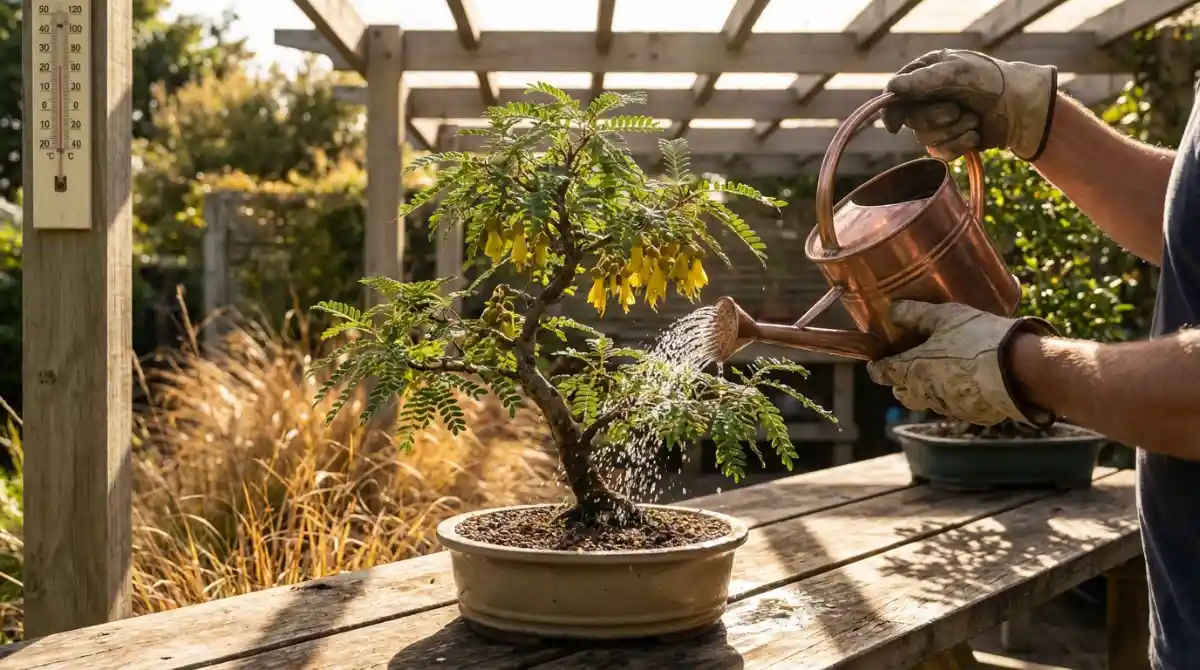
Water frequently and thoroughly. On hot, windy days, some trees may need watering multiple times a day. Check the soil moisture daily – don’t rely on a schedule. Water until it drains freely from the bottom of the pot. Consider placing bonsai on humidity trays filled with gravel and water to increase local humidity, particularly for species prone to drying out.
“During peak summer, a bonsai’s survival hinges on consistent and correct watering. Under-watering can be fatal in hours, while over-watering suffocates roots.”
2. Protecting from Intense Heat
Move sensitive species, or all bonsai on extreme days, to a shadier location or under shade cloth. This reduces direct sun exposure and helps prevent scorching. Elevating pots off the ground improves air circulation around the root ball, preventing overheating. Avoid intense pruning during the hottest periods, as fresh cuts can stress the tree.
3. Pest & Disease Management
Warm, humid conditions can be a breeding ground for pests like aphids, spider mites, and scale. Inspect your trees regularly, especially the undersides of leaves and new growth. Early detection is key. Use organic insecticides or horticultural oil sprays as needed, ensuring they are applied during cooler parts of the day to prevent leaf burn.
Summer Action Checklist
- ✅ Check soil moisture multiple times daily; water thoroughly.
- ✅ Provide shade during the hottest part of the day.
- ✅ Increase local humidity with humidity trays.
- ✅ Regularly inspect for pests and diseases.
- ✅ Avoid major pruning or repotting.
Autumn Care: Preparation for Winter
Autumn in the Southern Hemisphere is a period of transition and preparation. For deciduous species, leaves begin to change colour and fall, while evergreens consolidate their growth. Your focus now shifts to hardening off your trees, reducing growth to prepare them for the colder, dormant months ahead.

1. Reducing Fertiliser Intake
Gradually reduce the nitrogen content in your fertiliser and shift towards a fertiliser higher in phosphorus and potassium. This promotes root development and hardens woody tissues, rather than encouraging soft new growth that would be vulnerable to winter frosts. By late autumn, cease fertilisation altogether for deciduous trees and significantly reduce it for evergreens.
2. Pre-Winter Pruning
Autumn is an excellent time for minor refinement pruning and some structural work for many species, especially evergreens. Remove any unwanted growth, thin out dense areas to improve air circulation, and refine the tree’s silhouette. This also helps reduce energy expenditure over winter. Avoid heavy pruning that could stimulate new growth too close to winter.
“Autumn is the time to consolidate your bonsai’s health and form, ensuring it has the reserves and resilience to face the dormancy of winter successfully.”
3. Final Pest Checks
Before winter sets in, give all your bonsai a thorough inspection for any lingering pests or fungal issues. Treat as necessary. A clean tree going into dormancy is a healthy tree emerging in spring.
Autumn Action Checklist
- ✅ Gradually reduce nitrogen in fertiliser; shift to P-K dominant.
- ✅ Cease fertilising deciduous trees by late autumn.
- ✅ Perform refinement pruning and thinning.
- ✅ Conduct thorough pest and disease inspection and treatment.
- ✅ Plan winter protection strategies.
Winter Care: Dormancy & Protection
Winter in the Southern Hemisphere is a period of dormancy for most temperate bonsai species. While growth slows or stops, it’s not a time for neglect. Protecting your trees from frost, strong winds, and excessive wetness is paramount, especially for delicate native species not accustomed to prolonged cold.

1. Protection Strategies
Move frost-sensitive species, including many Australian and NZ natives, to a sheltered location like an unheated greenhouse, garage, or under the eaves of your house. For hardy species, grouping them closely together can offer mutual protection. Protect pots from freezing solid, as this can damage roots. Some may benefit from wrapping pots in hessian or bubble wrap.
2. Minimal Watering Approach
Water significantly less in winter. Only water when the top inch or two of soil feels dry to the touch. The goal is to keep the soil slightly damp, not saturated. Overwatering in cold conditions can lead to root rot. Water during the warmest part of the day to allow excess moisture to evaporate before temperatures drop.
“Winter is a time for patience and vigilance. Minimal intervention, coupled with strategic protection, ensures your bonsai emerges healthy and vigorous in spring.”
3. Embracing Minimal Intervention
Avoid any major pruning or wiring during deep winter dormancy. The tree’s energy reserves are low, and wounds heal slowly, leaving them vulnerable to disease. This is a time for observation and planning for the exciting growth of spring.
Winter Action Checklist
- ✅ Move sensitive bonsai to a protected, frost-free area.
- ✅ Group hardier trees for mutual protection.
- ✅ Water sparingly, only when soil is dry to touch.
- ✅ Avoid major pruning or wiring.
- ✅ Ensure good air circulation to prevent fungal issues.
Regional Variations: Tropical vs. Temperate Zones
The Southern Hemisphere, particularly Australia and New Zealand, encompasses a vast range of climatic zones. Understanding your specific region’s climate is paramount for effective bonsai seasonal care southern hemisphere. A Callistemon (Bottlebrush) in the tropical north of Australia will have vastly different needs to a Nothofagus (Southern Beech) in the temperate south of New Zealand.
- Temperate Zones (e.g., Southern NZ, Tasmania, Victoria): These areas experience distinct four seasons, including cold winters with potential frosts. Most traditional deciduous and temperate native species (e.g., various Eucalyptus, Nothofagus, Leptospermum) thrive here, undergoing true dormancy. Winter protection is critical.
- Subtropical Zones (e.g., Sydney, Auckland, parts of Western Australia): Milder winters and hot, often humid, summers characterize these regions. Many native species (e.g., some Ficus, Acacias, Port Jackson Fig) may only experience a semi-dormancy or grow year-round, albeit slower in winter. Repotting windows might be extended, and frost protection is still important on colder nights.
- Tropical Zones (e.g., Far North Queensland, Darwin): These regions have wet and dry seasons rather than distinct hot/cold ones. Bonsai like tropical Ficus, Bougainvillea, or native Schefflera grow almost continuously. Care revolves around managing moisture during the wet season and ensuring adequate hydration during the dry. Dormancy, as understood in temperate climates, is largely absent.
Always research the specific needs of your native species. Local bonsai clubs are invaluable resources for regional advice.
Seasonal Pruning & Wiring Schedules
Integrating pruning and wiring into your seasonal care ensures continuous development of your bonsai’s structure and health. While specific timing varies by species, here’s a general Southern Hemisphere guide:
Pruning Schedule:
- Spring (September – November):
Heavy structural pruning for deciduous and many temperate evergreens (e.g., native Maples, Olives). Pinch back new shoots on evergreens to encourage ramification. Remove dead or crossing branches.
- Summer (December – February):
Maintenance pruning to control rampant growth. Defoliation for some species (e.g., Ficus) to reduce leaf size and encourage back-budding, but only on very healthy trees. Avoid heavy cuts during intense heat.
- Autumn (March – May):
Refinement pruning for evergreens. Remove any unwanted growth that appeared over summer. Prune back flowering and fruiting trees after they have finished their cycle. Avoid heavy pruning to stimulate new growth.
- Winter (June – August):
Minimal pruning. Only remove deadwood or address urgent health issues. For very hardy deciduous trees, some structural pruning can be done while the tree is bare, allowing for clear visibility of the branch structure.
Wiring Schedule:
- Spring (September – November):
Ideal time for initial wiring on most species. Branches are flexible, and rapid growth helps set the shape quickly. Monitor wires frequently due to rapid expansion.
- Summer (December – February):
Continue to apply and adjust wires as needed. Remove wires showing signs of biting into the bark. Wiring can be done on non-stressed trees.
- Autumn (March – May):
Good time for refinement wiring, especially on evergreens. Wires can generally stay on longer as growth slows.
- Winter (June – August):
Wiring can be done on hardy deciduous trees when bare. For evergreens, only apply wires if absolutely necessary and monitor closely.
Frequently Asked Questions (FAQ)
Q: How do I know when my Southern Hemisphere bonsai needs repotting?
A: The best way is to gently lift the tree from its pot and inspect the root ball. If the roots are densely circling the pot, forming a solid mass, or growing out of the drainage holes, it’s time to repot. For most temperate species, early spring (September-October) is the ideal period.
Q: Can I use Northern Hemisphere bonsai care guides?
A: While basic principles apply, always reverse the seasons. A guide stating “spring care in March” would translate to “spring care in September” for the Southern Hemisphere. Also, consider specific native species’ needs, as many Australian and NZ natives have unique requirements not covered by general guides.
Q: How do I protect my bonsai from harsh summer heat in Australia/NZ?
A: Provide afternoon shade, either by moving trees or using shade cloth. Ensure excellent air circulation and increase humidity with humidity trays. Water frequently and thoroughly, sometimes multiple times a day during extreme heatwaves. Avoid direct contact of black pots with hot surfaces.
Q: What’s the biggest mistake Southern Hemisphere beginners make with winter care?
A: The biggest mistake is often overwatering, especially for temperate species entering dormancy. Roots are less active in cold soil and are highly susceptible to rot if kept consistently wet. Another common error is inadequate frost protection for sensitive native species.
References
- Australian Bonsai Clubs Federation (ABCF) – Official Resources & Guides.
- Bonsai Society of New Zealand – Publications and regional care articles.
- Local Nursery & Horticultural Experts – Consult for specific native species advice.
- ‘The Bonsai Handbook’ by David Squire – General principles adapted to regional context.
- Online Bonsai Forums (e.g., AusBonsai) – Community knowledge and specific regional experiences.