Southern Hemisphere Bonsai Care
What You Will Learn
Master Southern Hemisphere bonsai care with our comprehensive guide! Learn about reversed seasons, regional climates, optimal watering, fertilizing strategies, and effective pest management for thriving bonsai trees south of the equator. Your ultimate southern hemisphere bonsai care guide starts here.
Southern Hemisphere Bonsai Care: Regional Guides & Tips
The art of bonsai, a miniature reflection of nature, transcends geographical boundaries. However, cultivating these living sculptures in the Southern Hemisphere presents a unique set of challenges and opportunities. With seasons diametrically opposed to their Northern Hemisphere counterparts, a tailored southern hemisphere bonsai care guide is not just helpful but essential for success. This comprehensive guide will navigate the nuances of climate, seasonal care, watering, fertilizing, and pest management, empowering enthusiasts south of the equator to cultivate thriving bonsai. Understanding these regional differences is the cornerstone of successful bonsai cultivation, ensuring your trees flourish year-round, adapting to the reversed rhythms of nature.
Understanding Southern Hemisphere Climates
The fundamental difference for Southern Hemisphere bonsai practitioners lies in the seasonal reversal. When it’s summer in the Northern Hemisphere, it’s winter down south, and vice-versa. This dictates every aspect of a southern hemisphere bonsai care guide, from repotting schedules to winter protection. But beyond this primary reversal, the vastness of the Southern Hemisphere encompasses a spectrum of climates, each presenting its own considerations for bonsai enthusiasts.
The Seasonal Reversal: A Core Concept
For those accustomed to Northern Hemisphere gardening advice, the first step is a complete mental recalibration.
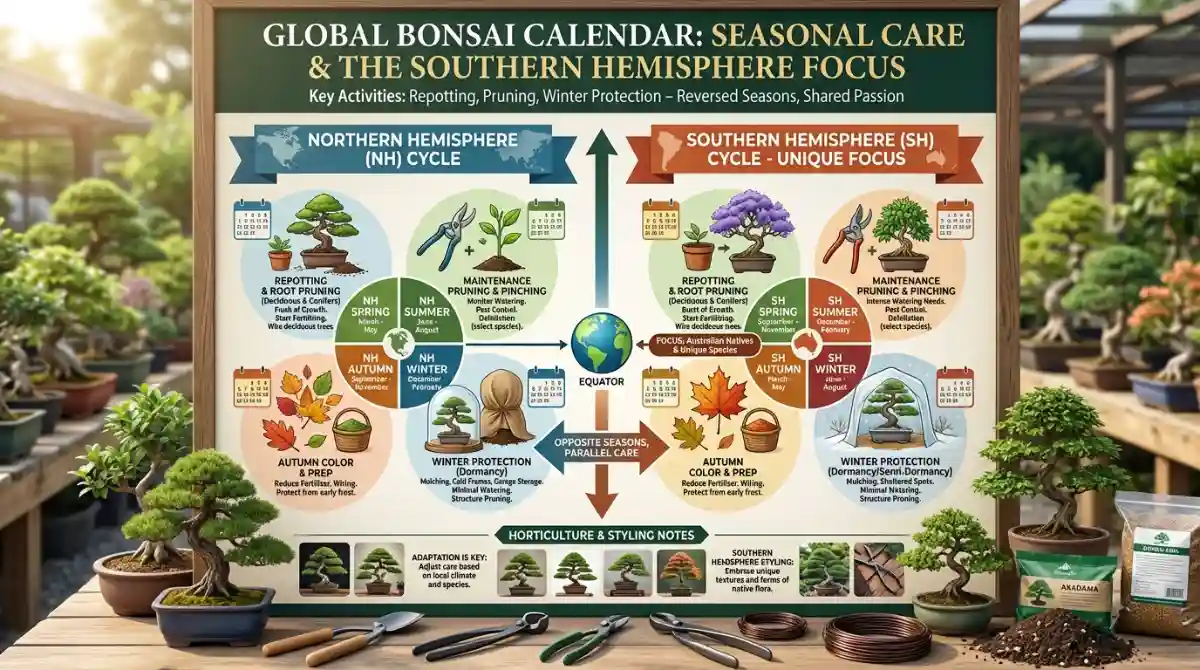
- Northern Hemisphere Spring (March-May) = Southern Hemisphere Autumn (March-May)
- Northern Hemisphere Summer (June-August) = Southern Hemisphere Winter (June-August)
- Northern Hemisphere Autumn (September-November) = Southern Hemisphere Spring (September-November)
- Northern Hemisphere Winter (December-February) = Southern Hemisphere Summer (December-February)
This direct opposition profoundly impacts critical care timings:
- Repotting: Often done in late winter/early spring in NH. In SH, this means late August/early September, as the trees emerge from dormancy and sap begins to rise. Learn more about optimal repotting times.
- Hard Pruning: Similarly, severe structural pruning is best done just before the growing season, aligning with late winter/early spring in SH. Explore bonsai pruning techniques.
- Winter Protection: The coldest months (June-August) necessitate careful protection from frost and cold winds for susceptible species. See our winter protection guide.
- Summer Watering: Intense heat and rapid evaporation during December-February demand diligent watering routines. Master bonsai watering strategies.
Regional Climate Variations and Their Impact
The Southern Hemisphere is not a monolithic climate zone. It includes diverse environments ranging from tropical and subtropical regions to temperate zones and arid landscapes. Each demands a nuanced approach within any effective southern hemisphere bonsai care guide.
- Temperate Zones (e.g., parts of Australia, New Zealand, Chile, Argentina, South Africa): These regions experience distinct four seasons, though often milder than severe Northern Hemisphere winters. Deciduous species thrive here, experiencing clear dormancy cycles. Evergreens also do well, but may require protection from occasional severe frosts. Examples include regions like Melbourne, Australia; Auckland, New Zealand; Santiago, Chile; and Cape Town, South Africa. In these areas, the traditional seasonal care outlined later in this guide is most applicable. Gardeners here can successfully cultivate a wide range of species, from maples and elms to junipers and pines, with appropriate species selection for local microclimates. The challenge often lies in managing temperature fluctuations and ensuring trees receive adequate winter chill for proper dormancy in deciduous species without suffering frost damage to their root systems in pots.
- Subtropical Zones (e.g., Queensland, Australia; KwaZulu-Natal, South Africa; Southern Brazil): Characterized by warm, humid summers and mild, often dry winters. True dormancy for deciduous species may be less pronounced, or not occur at all for some species. This means a longer growing season but also increased risk of fungal diseases and pest proliferation year-round. Watering needs are generally higher due to humidity and heat. Species like Ficus, Portulacaria afra (Dwarf Jade), and various tropical fruit trees are well-suited here. The focus shifts from protecting against extreme cold to managing humidity, heat stress, and year-round pest pressure.
- Tropical Zones (e.g., Northern Australia, parts of South America and Africa near the equator): Here, seasons are often defined by wet and dry periods rather than temperature extremes. Bonsai care revolves around managing intense sun, heavy rainfall during wet seasons, and maintaining humidity during dry spells. True dormancy is rare or non-existent. Fast-growing tropical species like ficus, schefflera, and bougainvillea are ideal. The primary concerns are heat stress, root rot during heavy rains, and constant vigilance against pests and diseases that thrive in warm, humid conditions. Shading from intense midday sun is often crucial.
- Arid/Semi-Arid Zones (e.g., Central Australia, Karoo in South Africa): These regions present challenges of extreme heat, low humidity, and often harsh winds. Bonsai must be selected for drought tolerance and resilience. Watering strategies are critical, focusing on efficient water use and preventing rapid drying out. Protection from scorching sun and desiccating winds is essential. Succulent bonsai like Portulacaria afra or hardy natives are often the best choices.
Understanding your specific local climate within the Southern Hemisphere is paramount. It influences species selection, pot material, soil composition, and daily care routines. Local bonsai clubs and nurseries are invaluable resources for regional advice.
Seasonal Care Differences for Bonsai
Adapting your bonsai care regimen to the Southern Hemisphere’s reversed seasons is crucial. This section provides a detailed guide for each season, outlining key tasks and considerations.
Southern Hemisphere Spring (September – November)
This is the season of rebirth and vigorous growth, mirroring the Northern Hemisphere’s spring.
- Repotting: This is the primary time for repotting most deciduous and evergreen species. As new buds begin to swell and sap flow increases (typically late August to early October, depending on your exact location and species), the tree is ready.
- Process: Carefully remove the tree from its pot. Prune back approximately 1/3 to 1/2 of the root mass, focusing on removing thick, circling roots and encouraging a radial root system. Repot into fresh bonsai soil, ensuring good drainage.
- Post-Repotting Care: Place the tree in a sheltered, shaded location for several weeks to recover. Water thoroughly and avoid fertilization until new growth is well established.
- Initial Pruning and Wiring: As new shoots extend, begin structural pruning to refine the tree’s silhouette. Wiring can be applied to young, flexible branches to set their primary direction. Monitor wires closely to prevent biting into the bark as the tree grows rapidly.
- Fertilization: Once new growth hardens off (usually 3-4 weeks after repotting or when vigorous growth is evident), begin a consistent fertilization schedule. Use a balanced fertilizer (e.g., NPK 10-10-10 or slightly higher in nitrogen) to promote strong foliage development.
- Pest Watch: Spring brings an increase in pest activity. Regularly inspect your trees for aphids, scale, spider mites, and caterpillars. Early detection and treatment are vital.
Southern Hemisphere Summer (December – February)
Often characterized by intense heat and long daylight hours, summer is a period of rapid growth and potential stress.
- Watering Frequency: This is paramount. Trees will often need watering daily, sometimes twice daily, especially in hot, windy conditions or for trees in shallow pots. The “touch test” (feeling the soil surface for dryness) is essential. Water until it drains freely from the bottom of the pot.
- Shading: Protect sensitive species (e.g., Japanese Maples, some Azaleas) from the harsh midday sun, especially during heatwaves. Shade cloths (30-50% shade) can prevent leaf scorch and reduce water evaporation.
- Vigorous Growth Management: Regular pruning (pinch and clip method) is needed to maintain the tree’s shape and encourage ramification. Remove unwanted shoots, especially those growing downwards or inwards. Continue wiring as needed, but be extra diligent in monitoring for wire bite.
- Fertilization: Continue with a balanced fertilizer, perhaps shifting to one slightly lower in nitrogen and higher in phosphorus and potassium for established trees to promote overall health rather than just foliage if desired. Adjust frequency based on tree response and growth rate.
- Pest and Disease: Summer warmth can escalate pest and fungal issues. Continue vigilant inspections and proactive treatments. Ensure good air circulation to deter fungal diseases.
- Holiday Care: If you plan to be away, arrange for reliable watering. Automated drip systems, self-watering mats, or trusted neighbours are indispensable. Ensure trees are grouped together in a shaded spot to minimize water loss.
Southern Hemisphere Autumn (March – May)
As temperatures begin to cool, deciduous trees prepare for dormancy, and evergreens consolidate their growth.
- Preparation for Dormancy: For deciduous species, this is the time when leaves change colour and eventually drop. Reduce nitrogen in your fertilizer and switch to a high-potassium, low-nitrogen formula to harden off growth and strengthen roots for winter.
- Final Pruning and Wiring: Light pruning can still be done to refine shape. For deciduous trees, once leaves have fallen, the bare branches offer an excellent opportunity for structural evaluation and wiring. This is a good time to apply heavy bending wires if required, as sap flow is decreasing, and branches are less prone to breaking.
- Watering: Gradually reduce watering frequency as temperatures drop and evaporation slows. However, do not let the soil dry out completely, especially for evergreens.
- Pest and Disease: Monitor for any late-season pests that might try to overwinter on your trees. Clean up fallen leaves to reduce fungal spore overwintering.
Southern Hemisphere Winter (June – August)
The coldest months bring dormancy for many species and a period of reduced activity for all.
- Dormancy Care (Deciduous): Deciduous trees require a period of cold dormancy to thrive. Ensure they are exposed to sufficient cold temperatures, but protect their roots from freezing solid in pots.
- Protection from Frost and Cold Winds:
- Frost-Tender Species: Move tropical and subtropical species indoors or into a frost-free greenhouse or sheltered patio.
- Hardy Species: While hardy species can tolerate frost, their roots in shallow bonsai pots are vulnerable. Elevate pots off the ground, group them together, or place them against a south-facing wall (for maximum sun exposure in SH winter). Mulching the soil surface or burying pots in the ground or a larger container filled with sawdust/bark chips can insulate roots.
- Wind Protection: Cold, dry winds can desiccate branches. Provide windbreaks or move trees to sheltered locations.
- Reduced Watering: Water sparingly, only when the top inch or two of soil is dry. Overwatering in winter, especially when trees are dormant, is a leading cause of root rot.
- No Fertilization: Stop fertilizing completely during dormancy. Resume only when new buds begin to swell in late winter/early spring.
- Evergreen Care: Evergreens continue to photosynthesize, albeit at a reduced rate. They still require light and occasional watering. Ensure their foliage is kept clean.
- Indoor vs. Outdoor: For species requiring winter protection, choose locations that offer adequate light and protection without being overly warm, which could disrupt dormancy. A cool, bright sunroom or greenhouse is often ideal.